The project
Kernel began with a different question from most of my AI work: instead of asking how to make a language model behave more intelligently, I wanted to explore what I would build if the learner itself had to acquire useful behavior from experience. The project therefore treats learning, memory, attention, internal state, perception, and action selection as parts of a persistent adaptive system rather than delegating cognition to an LLM.
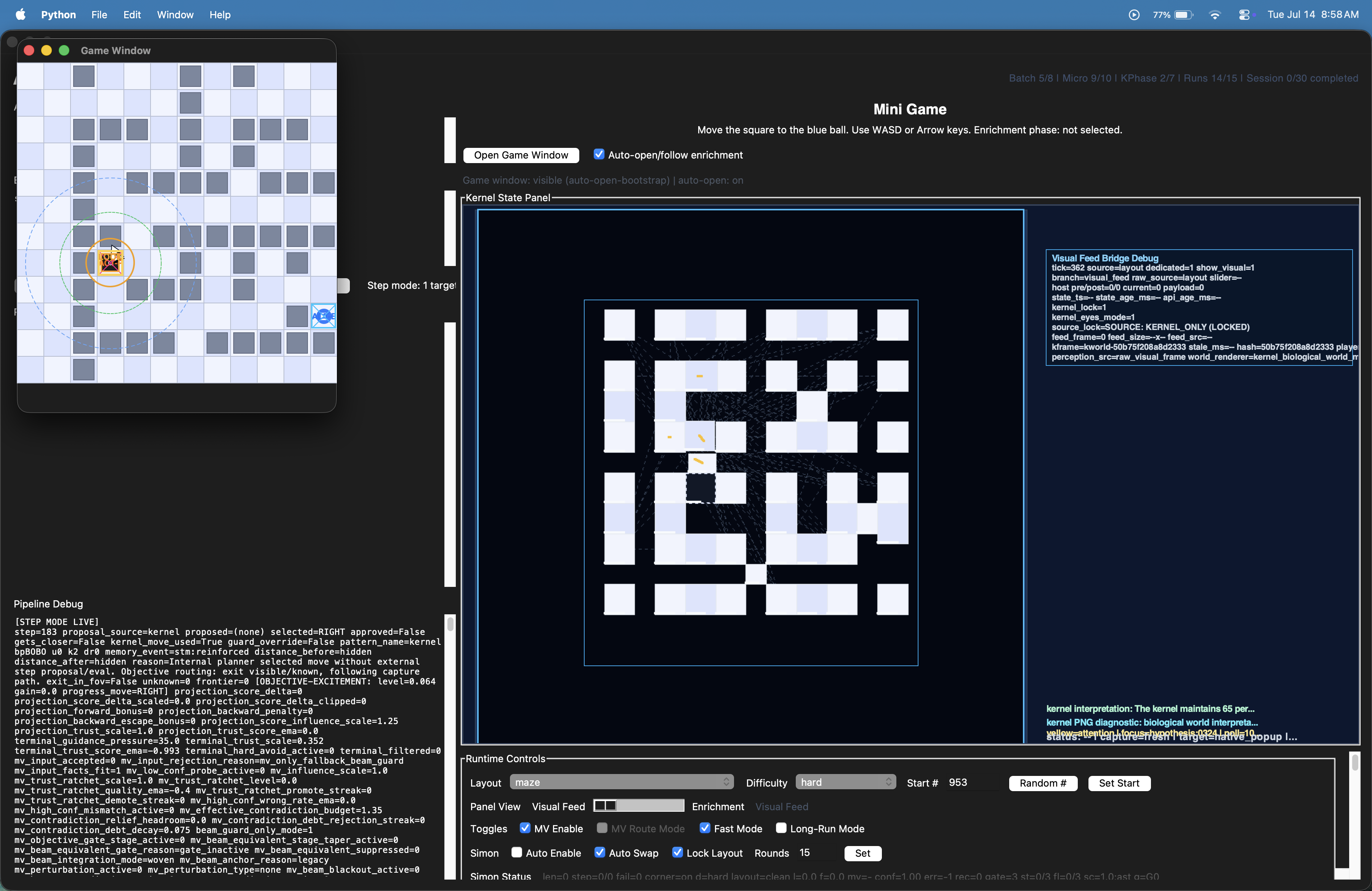
Development has proceeded experimentally rather than toward a fixed feature list. Mazes, visual reconstruction, short-term memory tasks, glyph and pattern learning, browser environments, and increasingly general visual interaction have been used as controlled environments for exposing specific capability gaps. Observed failures and unexpected behaviors become inputs to the next architectural iteration rather than being hidden behind a more capable external model.
01The challenge
Explore whether a persistent digital learner can acquire increasingly general representations and behavior from raw experience while keeping the source of that behavior inside the learner itself, rather than quietly replacing missing capabilities with language-model reasoning or task-specific scripted solutions.
02The approach
Treat capability development as an experimental loop: construct an environment that isolates a question, observe the learner's behavior and internal state, distinguish observations from interpretations, modify the architecture when the evidence justifies it, and test whether the resulting capability transfers beyond the environment that exposed the problem. The surrounding application, bridge, teachers, evaluators, and diagnostic systems are deliberately separated from Kernel-owned cognition so improvements in the experimental harness cannot be mistaken for improvements in the learner.